


Pobierz MP3
- Opowieść O czarnoksiężniku i trzech dziewicach
Konkurs na pamiątkę czytaj - Kolęda Hej w dzien narodzenia
Kolędy Podkarpacia czytaj - Kujawiak od Bachorzy
Od Kujaw po Bałtyk czytaj - Starej babie młodego się zachciało
- Piosenka dziecięca Sikoreczka pstra
Konkurs na pamiątkę czytaj
Partnerzy



Kontakt

2010-03-12 Family pottery
A big collection of the Konopczyński family pottery is in the possession of the Museum in Łowicz. It can be seen at a permanent ethnographic exhibition.
Throughout the last 100 years the products from this workshop have been astonishing people with variety of forms and ornamentation. Among them one can find both usable and decorative dishes, crocks, double-pots, bowls, jars vases, plates and mugs. In later period there also appeared cups, small kettles and sugar-bowls. Among the products there are also those, which are devoid of ornamentation or engobe, for instance strainer or holy-water basins.
On the picture: Double-pots from the museum in Łowicz that are produced today by the Konopczyński’s family present day generation.
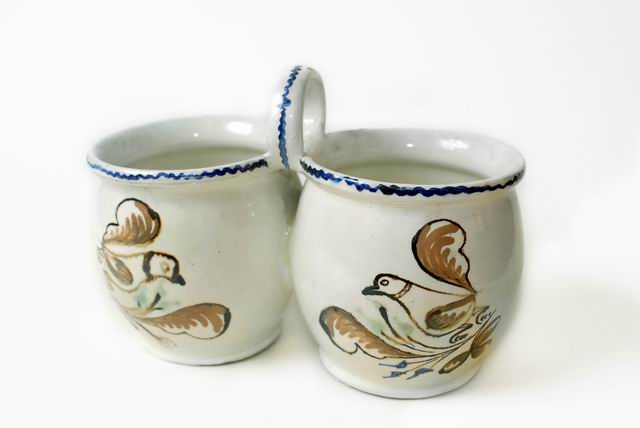
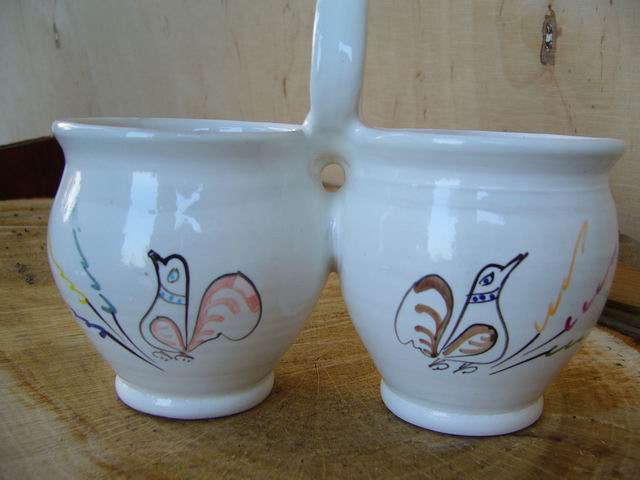
A characteristic motif of pottery from Bolimów workshop is that of a bird perched on a branch made with a soft line accompanied by flower motifs.
There is a legend behind this bird: “Once upon a time on a sunny day a potter fashioned over a dozen vessels. Just before afternoon, he carried them outside, so that they could dry out and went for his lunch. Upon his return, he got very upset, as all the vessels had been destroyed. Visible on them were prints of bird’s feet and its marks of its beak. The potter decided that as punishment he will from now keep painting the unruly bird on his vessels. It is not known whether such incident ever took place or if it was invented, but the bird has been preserved on the pottery up to the present day.
The pottery workshop was opened by Walenty Konopczyński (1863 – 1933), who had inherited his working skills from his father. A significant influence over the activity and the quality of products was made by Radziwiłów majolica manufacture in a nearby town Nieborów.
The pottery created in Walentego Konopczyńskiego’s workshop departed from local folklore standards, in both decorative and creative aspects. The vessels were covered with slip – engobe from kaolinic clay, which created a clear underlay making it possible to paint colourful ornaments.
In addition, the vessels were coated with transparent enamel, which made them look shining and made their surface smooth. High-quality products departed from bisque, poor in decoration vessels offered by local potters.
Walenty’s pottery, as much as that of his son, Stefan, in the later period, was very popular on the local market. It became the focus of interest among ethnographers and artists, and as a result the pottery from Bolimów workshop has been added to the collection of numerous museums.
Currently the works in the workshop are being performed by 3 generations of potters: Stefan’s son - Jan Konopczyński together with his daughter Dorota Konopczyńska –Aftewicz and her husband Paweł Aftewicz. The new generation of potters from Bolimów, by preserving the styles defined by their ancestors strives to introduce new forms of pottery and ornamental techniques.
Patryk Pawlaczyk - Museum in Łowicz www.muzeumlowicz.pl
Artyku�y polecane
- Tłusty czwartek
dodano: 2012-02-15 | ( komentarzy: 0 ) - Grupy zapustne
dodano: 2015-02-01 | ( komentarzy: 0 ) - Kujawskie zapusty
dodano: 2014-03-07 | ( komentarzy: 0 ) - Ceramika bolimowska
dodano: 2015-07-23 | ( komentarzy: 0 ) - Ścinanie Śmierci
dodano: 2012-02-23 | ( komentarzy: 0 )
Najcz�ciej czytane
- Kwiaty z bibuły
dodano: 2013-01-07 | ( komentarzy: 0 ) - Kwiaty z bibuły
dodano: 2011-05-18 | ( komentarzy: 0 ) - Przepis na krochmal
dodano: 2010-01-10 | ( komentarzy: 3 ) - Jak zrobić beczkę
dodano: 2012-09-17 | ( komentarzy: 0 ) - Wieniec dożynkowy
dodano: 2012-07-29 | ( komentarzy: 0 )